

A failed facelift due to a low-quality facility can lead to hypertrophic scars, facial asymmetry, or even necrosis. But don’t worry, the method of repairing a failed facelift at Gangwhoo will help overcome complications and restore your skin safely.
Signs of a Failed Facelift
A failed facelift is a condition where complications occur after a facelift procedure, causing the face to lose its natural appearance or leading to serious aesthetic and health problems. If you experience the following signs, it’s highly likely your facelift has failed:
- Excessively stretched skin: The face becomes stiff and loses natural expression.
- Facial asymmetry, imbalance: One side of the face is overly stretched compared to the other, causing facial asymmetry.
- Visible sutures or poor incision lines: If low-quality threads are used or the surgeon lacks skill, sutures may become clearly visible under the skin.
- Large scars, skin necrosis: Incisions that don’t heal well can leave unsightly scars, or even cause necrosis if infected.
- Loss of sensation in the stretched skin area: In some cases, excessive stretching can damage nerves, leading to temporary or permanent numbness.
Causes of a Failed Facelift
If you unfortunately undergo a facelift at a low-quality facility or encounter errors during the surgical process, you may face serious complications. Here are the main causes leading to a failed facelift:
Poor surgeon’s skill: If the surgeon lacks experience and poor technique, incorrect calculation of skin tension can lead to facial distortion, asymmetry, or even nerve damage. Additionally, an unskillful surgeon may leave unsightly scars, affecting the aesthetic outcome after surgery.

Outdated technology, substandard sutures: A failed facelift can also be caused by outdated technology that fails to meet aesthetic effectiveness. The use of substandard sutures can easily cause irritation, hypertrophic scars, or lead to rapid skin sagging.
Unsafe surgical environment: An operating room that does not meet sterile standards allows bacteria to enter the incision, causing severe infection. This is one of the leading causes of skin necrosis, seriously affecting your aesthetic results and health.

Improper post-operative care: Failure to follow the surgeon’s instructions, such as touching the incision, improper hygiene, or not adhering to appropriate dietary restrictions, can lead to slow wound healing, unsightly scar formation, or infection.
Methods for Repairing Failed Facelifts at Gangwhoo Cosmetic Hospital
Facelift is a solution for skin rejuvenation, but if performed at low-quality facilities or by inexperienced surgeons, the consequences can be extremely serious. Conditions ranging from unsightly scars, facial asymmetry, facial deformity, or infection leading to necrosis can still be corrected if the right method is applied.
At Gangwhoo Cosmetic Hospital, we apply advanced technologies and specialized treatment methods to effectively correct failed facelift cases, helping to restore our clients’ appearance.
- For unsightly scars after a facelift: The surgeon will perform a minor procedure to adjust the scar, changing the direction of the scar to align with the natural skin folds, helping the scar to be eliminated and fade over time. Additionally, the surgeon will combine other technologies such as laser and PRP therapy to accelerate the healing process and help the skin regenerate naturally.

For facial paralysis due to facelift complications: In this case, the surgeon will apply endoscopic microsurgery to regenerate and restore damaged nerves. Simultaneously, adjustments will be made to promote nerve reconnection, helping the facial muscles gradually regain flexibility and return to a natural state without stiffness.
For infection, skin necrosis: The solution to this condition will be implemented by the Gangwhoo team of doctors with an intensive antibiotic treatment protocol. This helps to completely control bacteria without affecting the skin structure. For severely damaged skin areas, the surgeon will apply skin flap rotation and shaping techniques to restore the skin without leaving contractures or unsightly scars.
For facial asymmetry, deformity after facelift: To correct facial asymmetry and deformity after surgery, doctors will use AI computed X-ray technology to accurately assess the facial proportions. Then, they will proceed with endoscopic microsurgery techniques to readjust the position of skin tissues, creating harmony among different facial areas.
Standardized Procedure for Failed Facelift Repair at Gangwhoo Cosmetic Hospital
Repairing a failed facelift is a complex aesthetic procedure, requiring highly specialized doctors to correctly assess the cause and choose the appropriate intervention method. Currently, Gangwhoo Cosmetic Hospital is applying a standardized failed facelift repair procedure including the following steps:
Step 1: Doctor’s examination and assessment of the condition
The doctor will directly examine the facial skin area to assess the extent of the damage, identifying issues such as contracture scars, uneven sagging, nerve damage, or facial deformities. Combined with medical imaging such as CT scans or soft tissue ultrasound, the doctor can identify complications before proposing a suitable treatment plan.

Step 2: Develop a personalized treatment plan
Each case of failed facelift repair will have a different corrective approach depending on the cause and extent of the damage. The doctor will propose treatment methods such as scar tissue excision, repositioning of the superficial musculoaponeurotic system (SMAS), or endoscopic facelift surgery to restore the overall facial appearance.
Step 3: General health check-up
You will undergo a general health check-up including blood tests, electrocardiogram, blood pressure measurement, etc., to ensure safety before surgical intervention.
Step 4: Anesthesia or general anesthesia depending on the extent of intervention
Depending on the extent of repair needed, the doctor may recommend local anesthesia or general anesthesia. Minor adjustments may only require local anesthesia, while complex surgeries such as large tissue reconstruction may require general anesthesia to ensure safety and comfort.
Step 5: Proceed with the failed facelift repair
Depending on the specific condition, the doctor may perform appropriate failed facelift repair methods to effectively improve complications. Here are some common corrective approaches for failed facelift cases at Gangwhoo:

- Excising scar tissue and recreating suture lines to limit contractures and help the skin heal more smoothly.
- Readjusting the SMAS layer to correct uneven skin tension and prevent recurrent sagging.
- Antibiotic treatment protocol to control infection, preventing the spread of damaged areas.
- Performing local flap rotation and shaping to fill in depressions or missing tissue, creating more natural contours (if any).
- Applying laser or stem cells for skin regeneration, reducing hyperpigmentation and scars, helping the skin recover quickly.
Step 6: Post-operative care instructions
After surgery, the doctor will provide instructions on how to clean the incision, use anti-inflammatory and anti-scarring medications to help the wound heal quickly. They will also schedule regular follow-up appointments to monitor the recovery progress, evaluate results, and may combine additional supportive methods such as therapeutic massage, laser scar removal, or PRP injections if needed.
Images of Facelift Scar Repair at Gangwhoo Cosmetic Hospital


Where to Get Safe and Effective Failed Facelift Repair?
To thoroughly correct a failed facelift, you need to find a reputable aesthetic facility with modern technology and highly skilled professionals. Among current aesthetic facilities, Gangwhoo Cosmetic Hospital is where all safety criteria are met, helping many clients regain their confidence.
Gangwhoo pioneers the application of modern technologies such as 4K endoscopy, harmonic scalpel, microsurgical techniques, robotic arms, etc., bringing precise interventions, less invasion, shortened recovery time, and minimized complications.
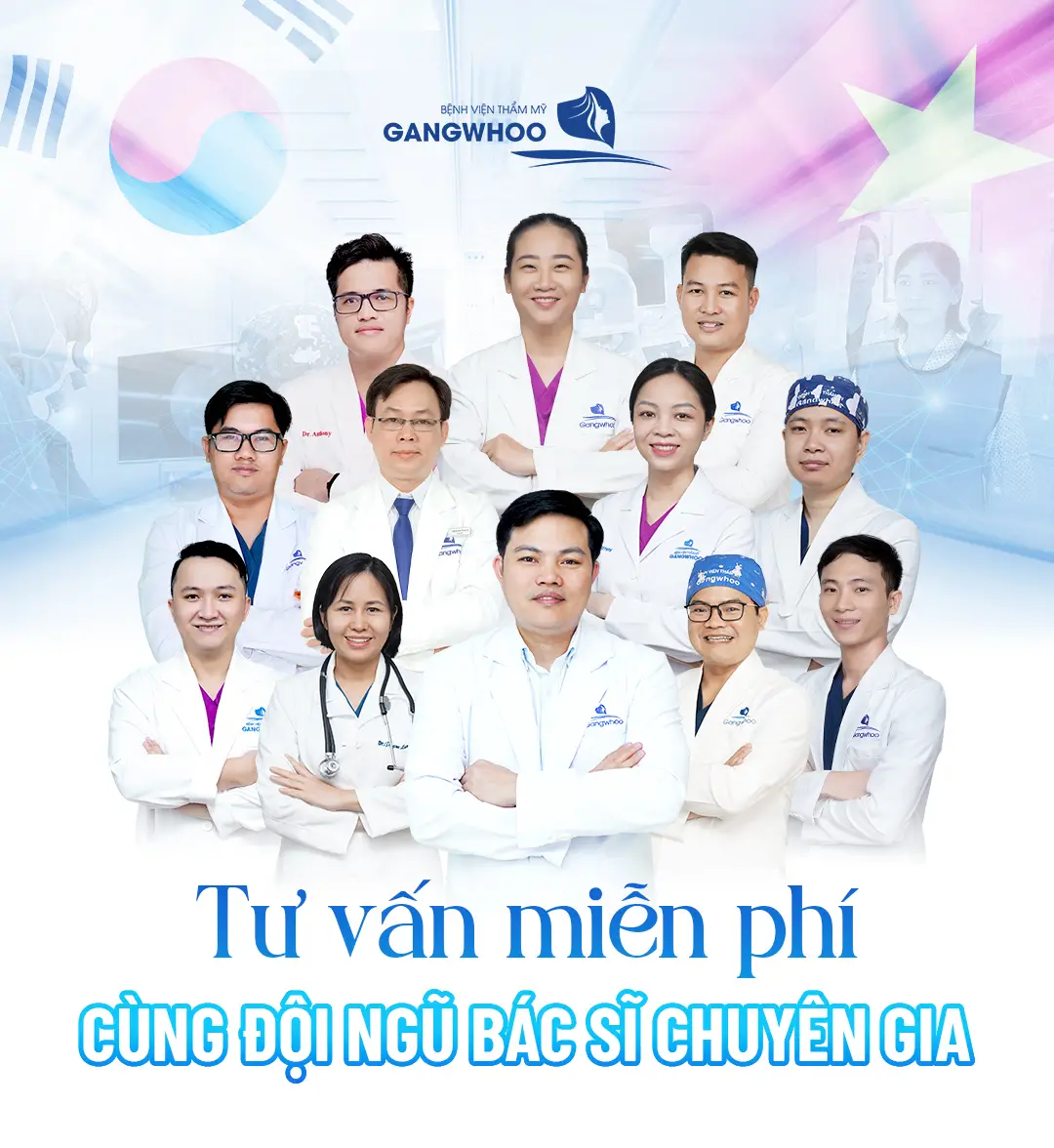
Gangwhoo is proud to own a team of highly qualified doctors, holding practice certificates and regularly undertaking further training in leading aesthetic countries such as Korea, the US, Thailand, Singapore,… This helps doctors constantly update new trends, improve techniques, and ensure optimal aesthetic results for correction.

The entire failed facelift repair process at Gangwhoo is performed in a sterile, aseptic environment meeting medical standards, ensuring absolute safety for clients. The process is standardized from consultation to post-operative care.
Gangwhoo is not only outstanding in expertise but also highly rated for its thoughtful and dedicated customer care service. The nursing team provides 24/7 support, ready to answer all questions and ensure clients have a secure experience from consultation to full recovery.

Gangwhoo has successfully performed thousands of facelift correction cases, helping many clients regain smooth skin and confidence. Each result is not only a testament to the doctors’ skill but also demonstrates the commitment to quality and dedication in aesthetic services.
How to Prevent a Failed Facelift
Facelift helps rejuvenate the skin, but if done incorrectly, it can cause serious complications. To ensure safety and achieve optimal results, you need to adhere to the following prevention methods:

- Choose a skilled and experienced doctor: The surgeon’s skill determines 90% of the facelift result. Choose a specialist with a practice certificate, many years of experience, a thorough understanding of facial anatomy, and an awareness of new technologies.
- Perform at a standard hospital: Facelift is an invasive surgery, requiring an absolutely sterile environment. It should only be performed at a cosmetic hospital with modern operating rooms, ensuring maximum safety.
- Choose the appropriate method: Consult your doctor to choose the appropriate method, whether it’s endoscopic facelift, full facelift, or thread lift, depending on your aging condition.
- Health check before surgery: A general health check helps ensure you are fit for a facelift, avoiding risks such as bleeding, infection, or anesthesia complications.
- Proper post-operative care: Adhering to post-operative care instructions helps the wound heal quickly and prevents unsightly scars. Avoid scar-causing foods, clean the incision correctly, and attend follow-up appointments as scheduled.
- Do not overuse facelifts: Excessive stretching can make the face stiff, unnatural, and even cause nerve damage. The interval between facelifts should be 8 – 10 years to ensure safety.
Summary of Some Frequently Asked Questions About Failed Facelift Repair
| Can a failed facelift be completely corrected after revision? | It is entirely possible to correct; even severe complications after skin restructuring surgery can still optimally improve the condition. |
| How soon can a facelift be revised? | Depending on the extent of the damage, mild cases can be adjusted early, but severe complications require waiting about 3-6 months before corrective surgery can begin. |
| Is the cost of revising a failed facelift expensive? | The price will depend on many factors, including the extent of the damage, the repair method, the performing doctor, and the aesthetic facility. |
| Are complications from a failed facelift dangerous? | Complications from a failed facelift are very dangerous if not corrected promptly. |
Correcting a failed facelift is a necessary solution to overcome complications, helping you quickly regain your beauty and confidence. We hope that the information shared in the above article will be useful and help you better understand the treatment methods.
If you have any further questions about our services or need other assistance, please don’t hesitate to contact Gangwhoo Cosmetic Hospital for early CONSULTATION and SUPPORT!