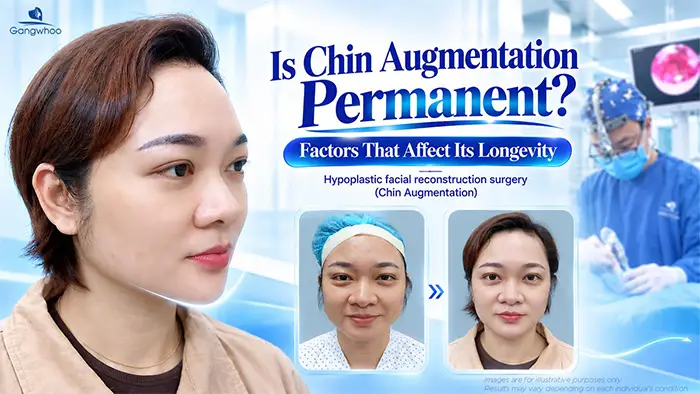



Chin augmentation helps change the projection and shape of the chin through the use of an implant or appropriate contouring techniques. However, in clinical practice, quite a few patients still wish to further refine the contours of the chin with filler after undergoing chin augmentation.
Therefore, a question I frequently encounter is: “Can you get filler after chin augmentation?”
The answer is yes, it may be considered in certain cases, but not everyone is suitable, and filler should not be injected arbitrarily after chin augmentation. Before making a decision, the doctor needs to assess the condition of the chin after surgery, the position and stability of the implant, the soft tissues, as well as the aesthetic concerns the patient wishes to improve.
From an Oral and Maxillofacial Surgery perspective, I believe that the important thing is not to find a way to “add filler” as soon as possible, but to accurately determine whether the current imperfection lies in the chin structure or the soft tissues. This is the basis for selecting an appropriate correction method.
Can you get filler after chin augmentation?
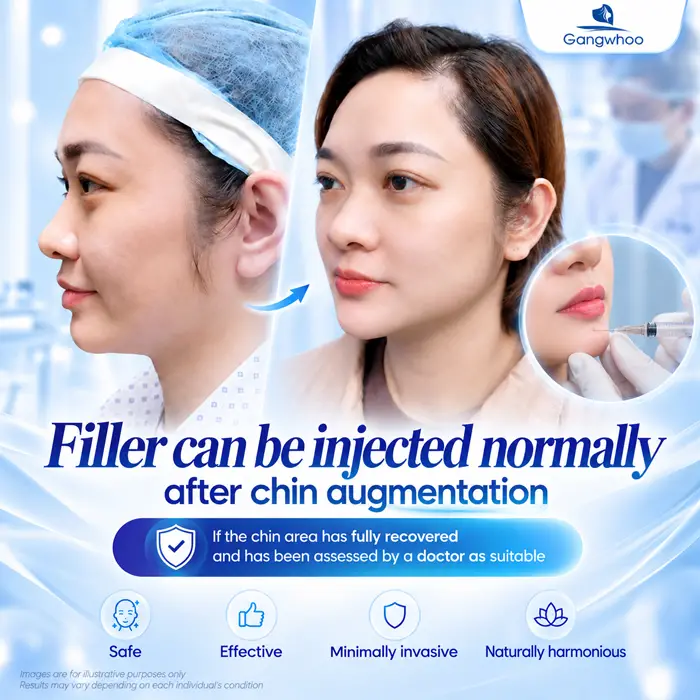
Filler can still be injected after chin augmentation in certain cases, provided that the chin area has healed appropriately and the doctor determines that filler can address the issue the patient is experiencing.
Chin augmentation with an implant and filler injection are two methods that work through different mechanisms. An implant changes the shape and projection of the chin through a solid material placed in the chin area. Filler, on the other hand, is a dermal filler injected into the soft tissues to add volume or refine contours. ASPS also notes that filler may be used in certain cases to “touch up” the results after chin surgery instead of proceeding with another surgery, but this option must be considered on an individual patient basis.
Therefore, I do not view the question “Can you get filler after chin augmentation?” simply as a yes-or-no question. The more important question is:
What is currently lacking in the chin, where is the problem originating, and can filler actually resolve it?
If the implant is stable but the soft tissues or chin contours still require refinement, the doctor may consider filler. Conversely, if the problem originates from the position, size, or shape of the implant, injecting additional filler may not address the underlying cause.
How long after chin augmentation can you get filler?
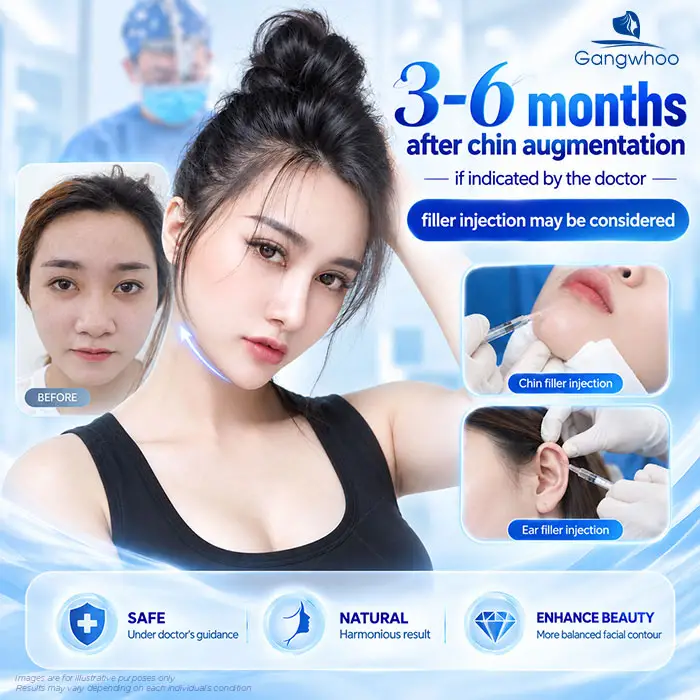
After chin augmentation, the safest time to consider filler is approximately 3–6 months, and I generally prefer to wait a full 6 months to allow the chin area to recover and become more clearly stable.
The 3-month mark should only be considered when the swelling has completely subsided, there is no pain, there are no signs of inflammation or infection, the implant is stable, and the doctor who directly examines the patient confirms that the soft tissues have healed appropriately. For cases where swelling persists, the chin remains unstable, there is a sensation of tightness or pressure, or the results are not yet clear, it is advisable to continue waiting rather than rushing to inject filler.
After chin augmentation surgery, swelling may persist and temporarily alter facial contours. ASPS notes that swelling after chin surgery can make the initial results unclear and may take several months to fully subside. Therefore, evaluating the results too early may lead to inappropriate treatment recommendations or cause patients to misunderstand the actual outcome.
I usually advise patients not to have filler injected during the first few weeks or immediately after the chin has just reduced in swelling, but instead to attend follow-up appointments as scheduled and wait until the chin area has stabilized. A period of 6 months gives the doctor a more reliable basis for accurately assessing the implant position, chin projection, soft tissues, and any remaining imperfections, if present.
In particular, if the chin is experiencing increasing pain, unusual swelling or redness, discharge, significant asymmetry, or suspected signs of infection, the appropriate action is not to inject filler but to have the condition examined and the underlying cause addressed first. Only after the postoperative condition has been confirmed to be stable can the doctor consider whether filler is truly necessary and appropriate.
Why should you not have filler injected arbitrarily after chin augmentation?
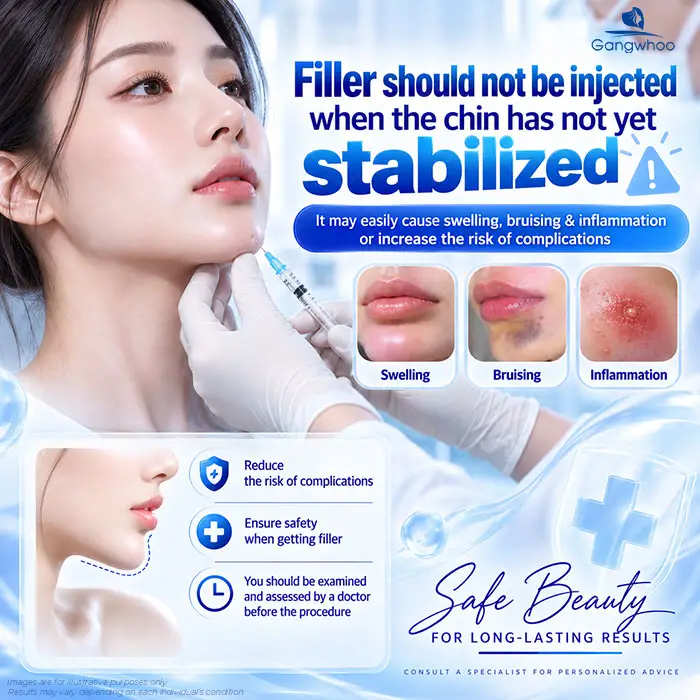
The chin is an area containing many important anatomical structures. After surgery, the soft tissues may still be swollen, sensitive, and not yet completely stable. If filler is injected too early, before the chin area has fully healed, several consequences may occur, including:
- Prolonged swelling and bruising: Tissues that are still healing may react more strongly to the needle and filler, causing swelling, redness, pain, or bruising to persist for longer.
- Difficulty accurately assessing the chin shape: Postoperative swelling can temporarily alter the shape of the chin. If filler is injected during this stage, it may be difficult for the doctor to determine which imperfections actually require correction, potentially resulting in an overly full or asymmetrical chin or an outcome that does not meet expectations.
- Increased risk of inflammation or infection: When the tissues have not fully healed, inserting a needle and filler into a recently operated area may increase the risk of inflammation, infection, or the formation of an inflammatory focus around the implant site.
- Potential impact on the stabilization of the implant: Mechanical effects from the injection process or a local inflammatory response may cause discomfort, alter the surrounding tissues, and make it more difficult for the doctor to assess the implant’s position and stability.
- Pressure or distortion of the chin contours: If filler is injected while the tissues are still edematous or the implant has not yet stabilized, the added volume may cause the chin area to feel tight or heavy, become uneven, or lose symmetry.
- Increased risk of nodules and uneven filler distribution: Postsurgical tissues are often not as soft and stable as normal. Filler may distribute unevenly, creating a hard or lumpy sensation or causing abnormal contour visibility.
- Masking signs of complications after chin augmentation: Swelling, redness, or pain after injection may make it more difficult to distinguish a normal reaction from signs of infection, fluid accumulation, or implant-related problems.
- Failure to address the actual reason for the patient’s dissatisfaction: If the chin shape is unsatisfactory because the implant is displaced, its size is inappropriate, or the chin structure has not been properly addressed, filler may only temporarily conceal the problem without correcting the underlying cause.
- Increased risk of vascular complications: Filler may inadvertently enter a blood vessel, causing vascular occlusion, tissue ischemia, and, in rare cases, necrosis, vision impairment, or stroke. The FDA also recognizes common reactions after injection, such as swelling, redness, pain, bruising, and tenderness at the injection site.
Anyone who has previously undergone chin augmentation should fully inform the doctor of the date of surgery, the procedure performed, and the type of implant used, if known. If the chin remains significantly swollen, becomes increasingly painful, red or warm, develops discharge, or shows any unusual signs, a follow-up examination is necessary before considering any additional procedure.
That is why I always emphasize: filler is a medical procedure, not a simple beauty service that can be performed arbitrarily.
What does the doctor need to check before injecting filler after chin augmentation?
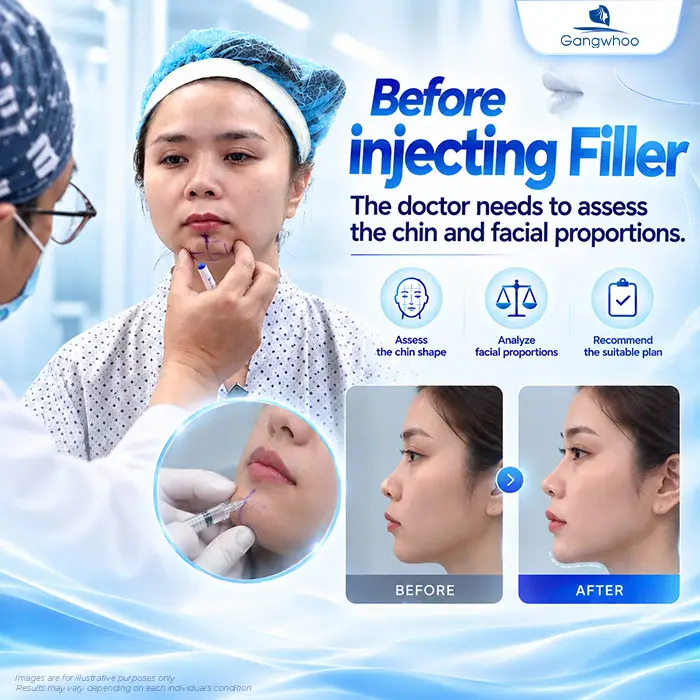
A consultation should not be limited to simply viewing the face from the front.
The doctor needs to examine the face from multiple angles, assess chin projection, the balance between the chin and the rest of the face, the condition of the soft tissues, and any abnormal signs that may be present.
Information about the previous chin augmentation is also very important. The patient should provide the date of surgery, where it was performed, the type of implant if known, and any other cosmetic procedures previously performed on the face.
ASPS also recommends that during consultation for chin surgery, the doctor should review the patient’s surgical history, medications, health condition, examine the face, and discuss treatment options as well as potential risks.
After the assessment, the doctor can determine whether filler is appropriate or whether the patient should continue monitoring the condition, have the implant adjusted, or choose another method.
At Gangwhoo Cosmetic Hospital, I prioritize identifying the cause before recommending treatment
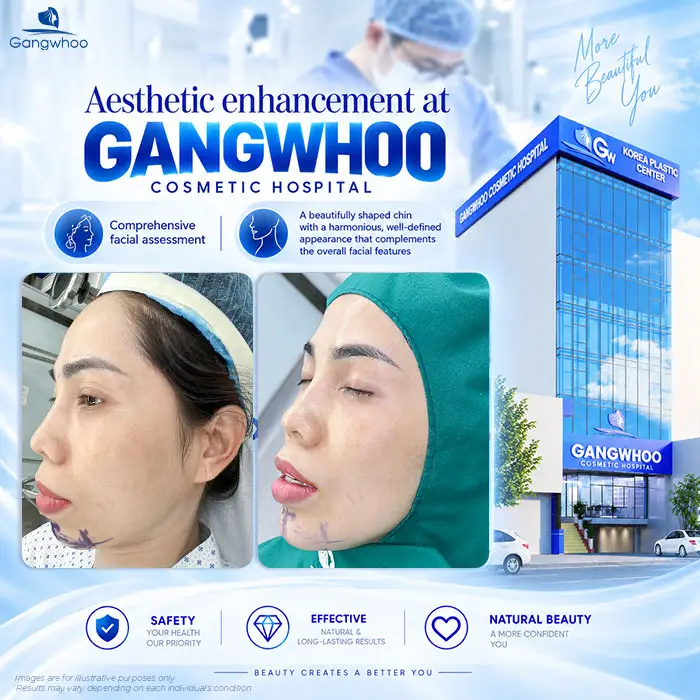
At Gangwhoo Cosmetic Hospital, I believe that a chin correction plan should not be developed solely based on the desire for the “chin to be longer” or “the chin to be more pointed.”
What matters is assessing the chin in relation to the entire face and the Oral and Maxillofacial structure.
The hospital’s current professional information identifies Dr. Nguyen Minh Hien as an Oral and Maxillofacial Aesthetic Doctor, who is part of the medical team at Gangwhoo Cosmetic Hospital.
From a professional perspective, I prioritize the principle of the right indication – the right timing – the right technique. Not every indentation requires filler, and wanting a more aesthetically pleasing chin does not necessarily mean that multiple methods must be combined.
The ultimate goal must be to create harmony among the chin, lips, lower jaw, and overall facial appearance, while respecting each individual’s anatomical structure.
The introduction of Gangwhoo Cosmetic Hospital also states that the hospital has a team of doctors and equipment serving aesthetic procedures.
Important considerations if you are recommended to have filler after chin augmentation
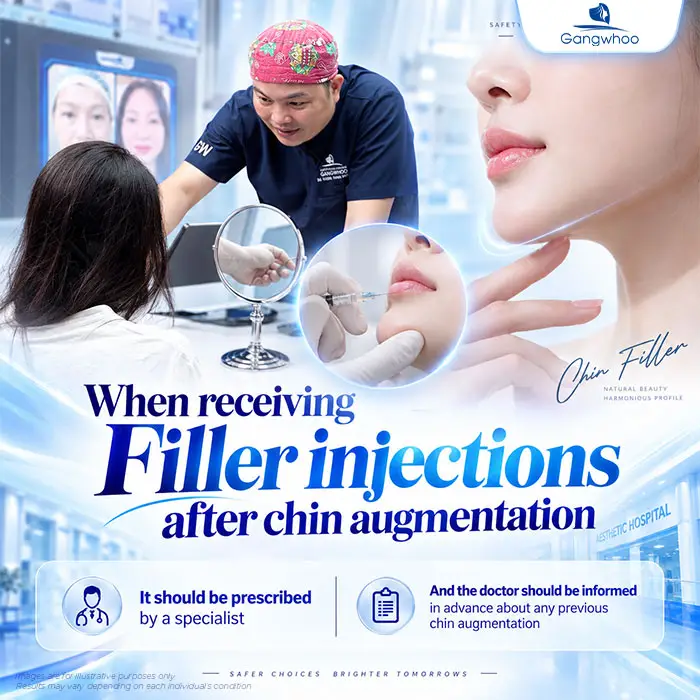
If, after examination, the doctor determines that you are suitable for filler, discuss clearly the type of product intended for use, its origin, the treatment objectives, and the potential risks.
You should also fully inform the doctor that you have previously undergone chin augmentation. This is information that should not be overlooked when performing any procedure in the chin area.
The FDA recommends that filler injections be performed by licensed healthcare professionals with appropriate training, using products supplied in accordance with regulations; the practitioner should also understand the risks and how to manage signs of complications if they occur.
In particular, if you experience unusual or rapidly increasing pain, pale or discolored skin, changes in vision, or neurological symptoms after injection, seek medical care immediately rather than waiting and monitoring the condition at home. The FDA recommends emergency treatment when signs suggestive of vascular occlusion occur.
Filler can be injected after chin augmentation in certain cases, but this is not the default option for everyone.
What I want to emphasize is that the decision should not be based solely on how long it has been since surgery or simply on the desire to make the chin fuller, longer, or more pointed. First, it is necessary to determine whether the chin area has stabilized, what condition the implant is in, and where the current imperfection actually lies.
If the issue is related to the soft tissues and filler is appropriate according to the indication, filler may be considered as a refinement option. However, if the cause lies in the implant or the underlying structure, injecting additional filler may not be the right solution.
If you have undergone chin augmentation but are not satisfied with the result, I recommend having a follow-up examination and an in-person assessment before undergoing any additional procedure.
At Gangwhoo Cosmetic Hospital, patients can consult directly with a doctor to have their chin condition assessed and choose an approach appropriate for their facial structure, rather than applying a one-size-fits-all formula to every case.